Check the mass along with the capacity
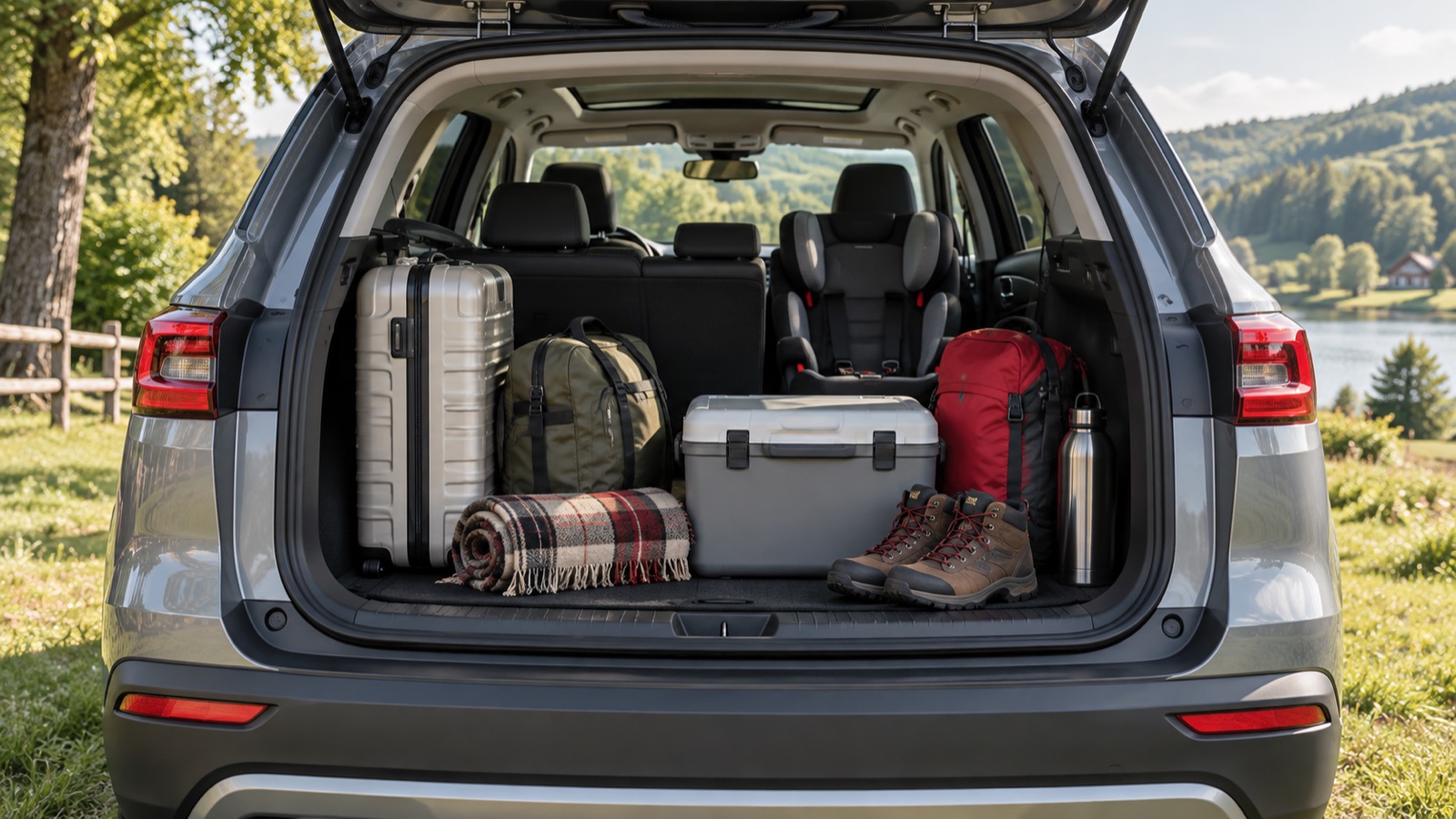
For a family trip, it's useful to ask two separate questions: will people and belongings fit, and will their weight fit within the vehicle's limitations. A photo of a spacious trunk only helps with the first. Before agreeing on the auction bid amount, prepare your loading scenario: a regular trip, a vacation, or transporting sports equipment.
This article will help you pass the pre-screening test for a candidate from the USA. It does not determine the permissible load of a particular car based on a photo. Compare the confirmed factory data and your own list of things, and leave unknown parameters as questions to the seller or reviewer.
Find the plate of this particular car
Ford explains in the Load Limit section: payload includes people and cargo. The maximum for the factory configuration is listed on the Tire and Loading Information near the driver's door. Additional equipment reduces the available load; trailer loads on the hitch are also taken into account.
Ask for a clear photo of the entire plate and a separate close-up of the kg or lb value. Rewrite the number with the unit. For calculations in kilograms, it is convenient to use the printed kg value, if available. Do not mix kilograms and pounds in the same subtraction.
Keep a link to the auction listing for the car and the factory manual for the version you want nearby. If the plate is missing, illegible, or the data contradicts each other, ask the manufacturer's representative to clarify the limitations. Values from another car of the same model should not be substituted as a confirmed result.
Calculate your own scenario
Ford's rule: Subtract the weight of the driver and passengers from the permissible total weight of people and cargo, then compare the remainder with the luggage. Take into account equipment added after production, if it is not already included in the established limit.
A hypothetical educational example, not a model specification or WonderCar case: suppose the plate allows 500 kg, people together weigh 300 kg, added equipment is 20 kg, and belongings are 130 kg. Calculation: 500 − 300 − 20 − 130 = 50 kg. This is the arithmetic remainder in the given scenario, not permission to add any cargo to any place.
For your own list, weigh your suitcases and gear, and factor in child seats, strollers, and other items. Don’t limit yourself to the weight of empty bags. Do a separate calculation for your busiest planned trip, and note which values are measured and which are still estimated. The example above does not include a trailer.
Distinguish between general limit and axis limits
Ford explains that GVWR means the maximum permissible weight of the loaded vehicle, GAWR means the permissible load on an individual axle. These are indicated on the certification plate. All applicable restrictions must be observed. Higher load tires do not, by themselves, increase the GVWR or GAWR.
So, record payload, GVWR and GAWR in separate fields, without substituting one for the other. If you are planning on heavy equipment, a roof rack or a trailer, formulate a separate question about the allowed configuration and how to verify the load. Simply subtracting the weight of the suitcases does not complete such a verification.
Ford warns that online instructions may differ from the documentation for your specific vehicle. The source provided explains the terms; it does not set numerical limits for all models. The selected candidate will need their plates and corresponding instructions.
Do not correct overloading with tire pressure
NHTSA recommends taking the recommended pressure from the vehicle placard or manual, rather than the maximum value on the tire sidewall. The check is performed on cold tires, after at least three hours of non-use. The absence of a TPMS signal does not replace a measurement: the system warns of a significant decrease in pressure.
Practical conclusion for selection: if your scenario exceeds the certified weight limit, review the cargo composition or vehicle selection. Do not write off the increase in pressure as a way to get additional payload. The condition of the tires, suspension and bodywork requires separate inspection; the plate alone does not confirm the serviceability of a used car.
What to prepare for comparing candidates
The editorial template will help you discuss two cars in the same scenario. Mark missing data with the word "clarify" so that the evaluation does not appear to be completed prematurely.
Through the WonderCar application form, you can discuss the selection of a family car for your trips. Prepare an auction ad for the car and this list of questions. The goal is to find a candidate with confirmed parameters for your scenario before the purchase.
- Photos of load plates and factory certification.
- Link to the manual for the desired model year and market.
- Total mass of people, list of things and their mass.
- A list of added equipment and information about whether it is included in the limit.
- Separate questions about roof, trailer and axle loads if they apply to your trips.
- There are known limitations and checks that still need to be performed.